
Selecting the correct Vacuum Bell version
The five different Vacuum Bell types
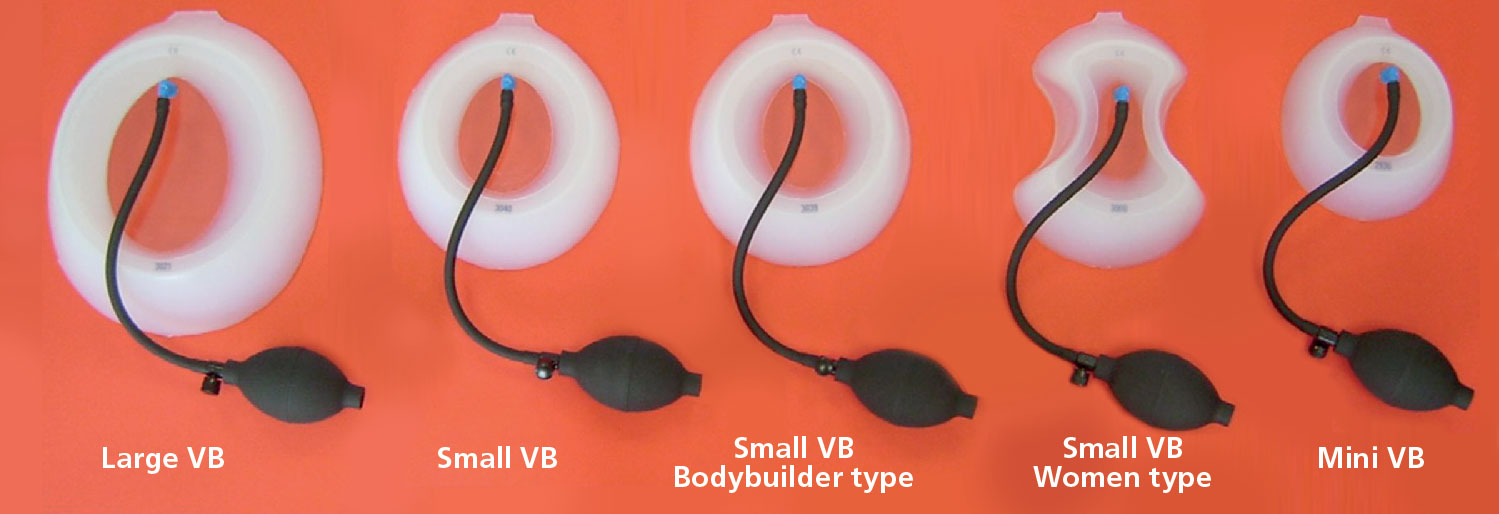
Correct selection is crucial for the treatment outcome, determined by:
● Age
● Height
● Weight
● Depth of deformity
● Straight line between the centres of the nipples
The vacuum bell should be:
●Large enough to anchor outside the funnel chest
● Placed directly over dry skin with excessive hair best trimmed
● Best placed over the centre of funnel chest (especially when asymmetric)
● Usually placed with the tubing nozzle at the top
● Fitted with the patient sitting or supine, as dizziness may occur initially
● Applied avoiding silicon edges crossing the centres of the nipples
Name |
Size | Product code |
|---|---|---|
Large Vacuum Bell |
26 cm | EKVB 26 AA |
Small Vacuum Bell |
19 cm | EKVB 19 AA |
Small Vacuum Bell Bodybuilder type |
19 cm | EKVB 19 BA |
Small Vacuum Bell Women type |
19 cm | EKVB 19 WA |
Mini Vacuum Bell |
16 cm | EKVB 16 AA |
Treatment protocol
● First week - maximum of 1 hour a day
● Second week - maximum of 2 hours a day
● Typical daily application: 1-3 hours, longer if possible
• Typical treatment duration: 1-3 years
● Typical treatment duration: 1-3 years
● Daily regime of physical exercises aiming to improve posture is recommended while using the Vacuum Bell
Correct selection is crucial for the treatment outcome, determined by:
● Treatment and relief of funnel chest and possible related sequelae (e.g. social withdrawal, chronic back pain, chronic bronchitis, etc.)
● Treatment, alleviation and compensation of disabilities such as, if applicable, reduced lung volume, impaired heart function leading to impaired physical performance
● Possible changes in chest wall anatomy and in psychological / mental health status
References
• SchierF, Bahr M, KlobeE. The vacuum chest wall lifter: an innovative, nonsurgical addition to the management of pectus excavatum. J PediatrSurg. 2005;40(3):496–500
• RedlingerRE Jr, Kelly RE, NussD, GoretskyM, Kuhn MA, Sullivan K, Wootton AE, EbelA, Obermeyer RJ. Regional chest wall motion dysfunction in patients with pectus excavatum demonstrated via optoelectronic plethysmography. J PediatrSurg. 2011 Jun;46(6):1172-6
• Hacker FM, ZuppingerJ, SesiaSB. Die conservative Therapieder TrichterbrustmittelsVakuuktherapie. Schweiz Med Forum. 2014;14(45): 842-849
• Lopez M, PatoirA, CostesF. Preliminary study of efficacy of cup suction in the correction of typical pectus excavatum. J PediatrSurg. 2016;51(1):183–187
• DeviggianoA, VallejosJ, ViñaN, Martínez-Ferro M, et.al. Exaggerated interventricular dependence among patients with pectus excavatum: combined assessment with cardiac MRI and chest CT. American journal of roentgenology 2017;208(4):854-861
• MontiniO, VoulazE, MaagaardM, et.al. Right ventricular changes after vacuum bell correction of pectus excavatum. European Heart Journal 2017;38 (Suppl1)
• Obermeyer RJ, Cohen NS, Kelly RE. Nonoperative management of pectus excavatum with vacuum bell therapy: a single centerstudy. J PediatrSurg. 2018;53(6):1221–1225
• Patel AJ, Hunt I. Is vacuum bell therapy effective in the correction of pectus excavatum? Interact CardioVascThoracSurg 2019.


Tel: 0191 258 8944 Fax: 0191 622 0117
sales@braceorthopaedic.co.uk
