Category Archives: CDS

Use of the Brace Orthopaedic CDS Ankle Brace for Long Covid-19 patients

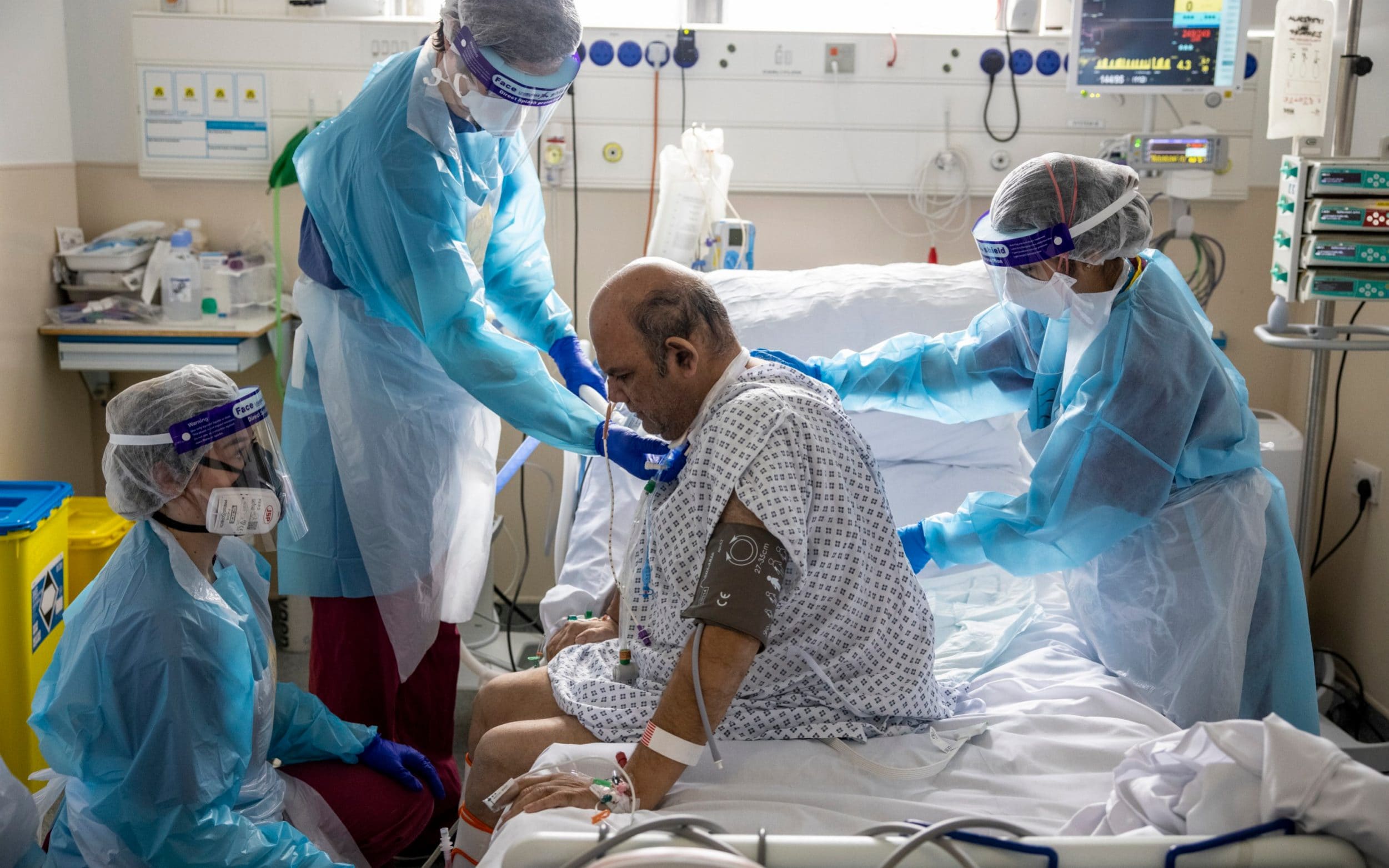
It is over twelve months now since the beginning of the Coronavirus pandemic. Whilst we have gained a better understanding of the virus, treatments and introduction of vaccines, the healthcare community are still learning about the long-term effects of the virus.  This is being seen in large numbers of Covid sufferers, which in some cases includes the need for complex rehabilitation.

Patients are presenting with symptoms not unlike neurological conditions. Covid 19 patients and in particular those long lie patients in intensive care quickly loose muscle bulk as they atrophy, which renders the individual incredibly weak when rehabilitation commences.  The other concern is the associated loss of range of motion (ROM) and particularly the ankle joint.  If the ROM is restricted beyond 90 degrees, this compounds the effects of muscle weakness and efforts to walk.

At Brace Orthopaedic we believe we can offer a device which might have significant benefits for some of these patients. The CDS (Controlled Dynamic Stretch) Ankle Brace has been used for the treatment for neurological conditions within the NHS, such as Duchenne muscular dystrophy or stroke, where joint contracture is a threat.  Features of the CDS Ankle Brace include the ability to fine tune the spring tension force and turn it off and on, fine adjustment of the range of movement (ROM) and easy individual adjustment of shells and straps. It works by applying an adjustable dynamic stretch to the soft tissues by the means of medial and lateral spring-loaded ankle hinges, offering a dorsiflexion-assist force.  These can be fully adjusted to suit the needs of the individual, so protecting and not overstretching the soft tissue.

The CDS Ankle Brace can be used from the onset within an intensive care setting when reduced ROM is noticed, equally the use can be commenced in the “step down-ward” or rehabilitation setting. The aim is to commence treatment with lower spring tension to introduce dynamic stretch and increase as treatment/tolerance continues.  The initial minimum wear time should be for 30 minutes to 2 hours, but they can be worn for longer periods. One further advantage for the patient is that, as rehabilitation progresses, the CDS Ankle Brace has an ambulatory sole unit for continued indoor use. This can help both with maintaining/ improving the dorsiflexion ROM when the patient is sedentary (with the knee extended) and also with assisting the weak/ paretic dorsiflexors during gait, prior to switching to a conventional Ankle Foot Orthoses (if required).

If you would like to learn more about Brace Orthopaedic’s range of innovative orthoses or indeed arrange a product demonstration, then please contact Customer Services on 0191 258 8944 where Cathryn or Iain would be delighted to help. Alternatively, please visit our website at www.braceorthopaedic.co.uk

linkedinmail

Brace Orthopaedic – proud sponsors of BSCOS 2019

Brace Orthopaedic are proud to be sponsoring the British Society for Children’s Orthopaedic Surgery (BSCOS) current concepts course taking place at The Royal College of Surgeons state of the art facility in Edinburgh over the next 3 days.

The event is aimed at Consultant Surgeons, Registrars and AHP’s with a special interest in Paediatric Orthopaedics. The broad theme for the course programme is Acute medicine, Neuromuscular and Hips.

Brace Orthopaedic has expanded into the area of Paediatrics in recent years and are profiling the innovative CDS braces at BSCOS. These active dynamic orthoses (utilising spring-loaded hinges) for contracture management, provide a controlled, dynamic stretch to shortened soft tissue for joints in the upper and lower limb.The CDS range of orthoses are being used in a variety of pathologies within Paediatrics and it is specifically relevant that Day 2 of the programme is focusing on contracture management in relation to treating children with Cerebral Palsy.

NHS Hospitals throughout the UK are already using CDS braces for this specialist patient group and representatives from Brace Orthopaedic are looking forward to discussing some of the success stories with the delegates. The CDS braces include orthoses for the wrist, elbow, knee and ankle joints and are all available in Paediatric sizes and a range of different colours.

There has also been a great deal of interest in the Artisan Ankle resting splint, which is made from malleable aluminium and has detachable medial/lateral fixation plates allowing easy adjustments to Ankle ROM. These splints are available in 3 Paediatric sizes and can be used to treat children with Duchenne Muscular Dystrophy (DMD). It is often prescribed for night wear to stop the foot from dropping into Plantar Flexion and thereby keep the Achilles’ tendon stretched while the child is sleeping.

The BSCOS current concepts course is an educational event at the cutting edge of children’s orthopaedic surgery. The course only runs every 3 years and the Brace Orthopaedic team are looking forward to engaging with all the AHP’s in what is sure to be an excellent 3 day conference and exhibition.

linkedinmail

CDS knee brace enables man to walk in the great outdoors again

‘Vancouver near Stanley Park. A 6-7km walk which I could not have done without a great deal of physical discomfort, if not considerable pain’​

David M. was assessed by his Orthotist Mhairi Friel of the Foot and Leg Clinic in Glasgow and fitted with a CDS Knee Extension brace a few months ago, to help compensate for his quads weakness and to correct his knee hyperextension. This is his story:

“I have a background in exercise and knowledge base of sports science. I used to rock climb and was very adventurous. The increasing weakness in my quadriceps took a lot of my mobility away. The cause (as suggested by consultant neurologists at the Queen Elizabeth University Hospital) is lower spine nerve damage, likely as it branches to the left leg. The weakness manifested in 1999 and within a few years, certainly by 2005/6, I was locking out my left knee to walk. For clarity, on a standard, leg extension resistance machine, I cannot move, let alone lift the lightest plate, which in my own gym is 5Kg. I stopped climbing and more recently realised that my walking range (always on a locked-out knee) was becoming far shorter due to pain.

 I literally spent weeks, if not months, trying to find a device that would offer a resistance loading that would counteract the weak extension power of my quadriceps. I chose the CDS Knee Extension. And I needed a private consultant, Mhairi Friel, to order it. Mhairi is an excellent practitioner and nothing should be taken away from her knowledge and service. Without her amazing help and understanding, I’m not sure how things would have been.

 Prior to wearing the CDS Knee Brace, I would find my left knee painful after minimal walking distances (even on flat terrain), all due to the locking out of the joint. Although I also suffer from a weak gastrocnemius, the resistance of the mechanism allows me to walk with a more natural cadence. With the brace on, I found that there was no symptom of discomfort in my knee. In fact, it has been of great benefit to increase some functional performance in my gastrocnemius, especially from an endurance perspective. I have managed to walk up and down hills, even in rough terrain, without any major issue. Of course, I still fatigue but the pain is gone and that allows me to plan for a long journey. The CDS Knee Brace has given me the ability to place weight on a bent knee, taking away the need to constantly lockout. I use the tension function set at a relatively high level – 10. But that has given me tremendous support and confidence when walking. As mentioned, my walking style had also reduced the use of my lower leg muscles but with the brace forcing me to use plantar flexion, I have noticed slight growth and increased endurance, especially in the medial head of my gastrocnemius.

 This was essential for my recent trip to Canada where I knew I would be walking more than normal. Without the brace, I would not have been able to enjoy the sights I saw in my three-week adventure. In fact, without the brace, I have no doubt I could not have even reached those sights – and that is not an exaggeration. Apart from the functionality of the brace, it is remarkably comfortable, considering how much of my leg it covers. It is an invaluable part of my mobility. I literally cannot get far without it.”

“The above photo was taken after a 3.8km hike up into bear country – the view overlooks the town of Bella Coola, in British Columbia. Again, I can’t express enough how much this would not have been possible without the brace to support me both up and downhill.”
“This photo was taken in San Josef Bay, Vancouver Island. The walk was across flat terrain but was several kilometres. Again, this walk would have required constant locking out which would have made the trek unbearable. The knee brace took me to the edge of the Pacific Ocean.”
linkedinmail

Orthotic Management of Contractures – State of the Art

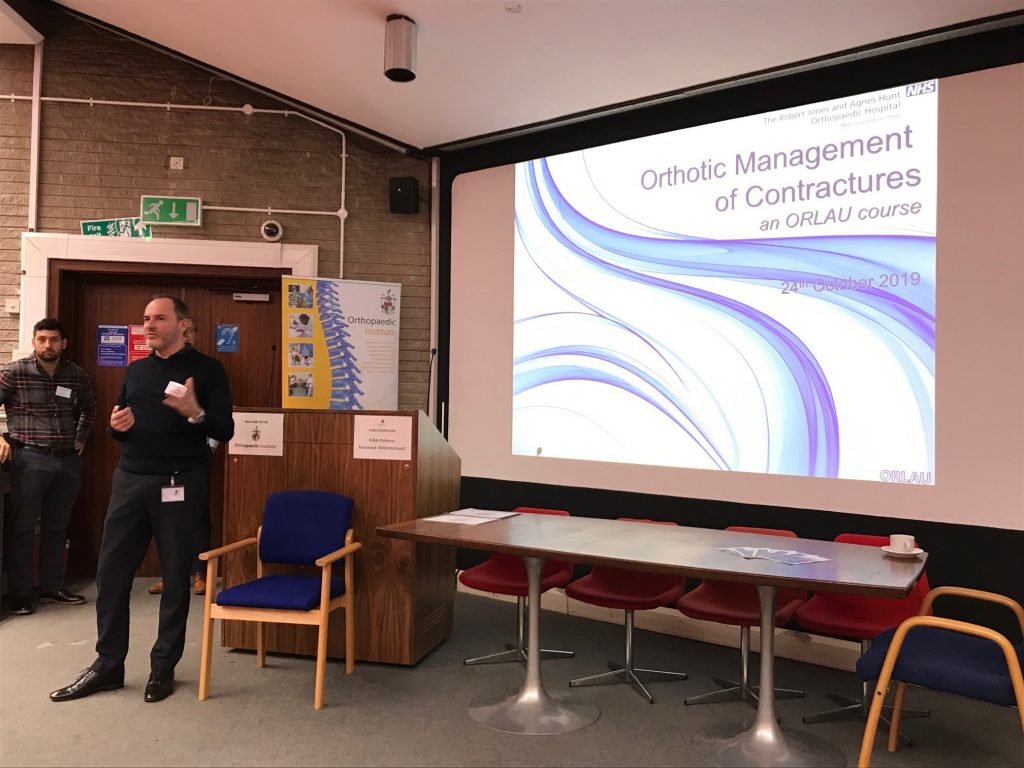
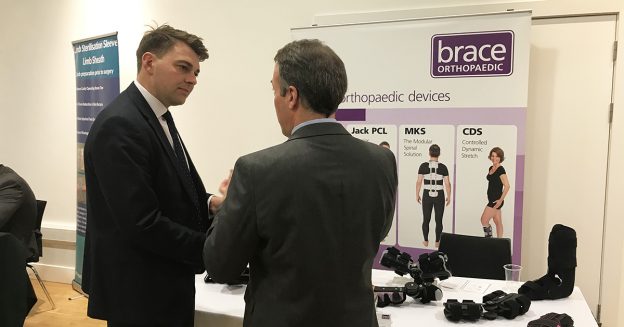
Brace Orthopaedic are proud to be sponsoring the “Orthotic Management of Contractures” course taking place at the Robert Jones and Agnes Hunt Orthopaedic Hospital in Oswestry today. The course run by the ORLAU (Orthotic Research & Locomotor Assessment Unit) is organised in conjunction with the Orthopaedic Institute.

Brace Orthopaedic distribute the leading range of active dynamic orthoses (utilising spring-loaded hinges) for contractures management in the upper and lower limb, called CDS (Controlled Dynamic Stretch), manufactured in Germany by Albrecht GmbH. The CDS range of orthoses are being used in a variety of pathologies including orthopaedic or neurological lesions, burns & plastics, etc. and cover all sizes of users from large adults to small children. The range includes orthoses for the wrist and hand, elbow, knee and ankle joints, with a recent addition of the only active dynamic orthosis to manage knee flexion contractures of below-knee amputees.

CDS orthoses allow clinicians to quantify the exact amount of force applied on the contracted tissues and define the exact range of movement allowed (with increments as little as one degree and even allowing hyperextension, if required). Features like the easy shaping of the aluminium shells around the limb without the need for a heat gun and the positional adjustment of each shell proximally-distally ensure an optimal fit for users of very different shapes and sizes. User compliance is maximised not only through the careful adjustment of the forces utilised, but also by features such as the large, anatomically shaped shells to minimise applied pressures, the air permeability of the shells, the simple on-off switches for the spring tension and the ski boot-type clips for easy donning-doffing. Significantly, unlike static methods of contractures management, the functional use of the limb treated is being maintained and even enhanced by the use of the forces which can supplement the function of weakened muscles, in order to assist the user to participate in activities of daily living (ADLs).

The Orthopaedic Institute is a charity, in existence since the 1970s and was formed to provide funds for Education and Research in the various Departments of the Robert Jones & Agnes Hunt Orthopaedic Hospital. If you are interested in reading about the research and education projects they have supported then please visit www.orthopaedic-institute.org.

If you would like to hear more about Brace Orthopaedic’s range of CDS active dynamic orthoses or indeed arrange a product demonstration, then please call Customer Services on 0191 258 8944 where Cathryn or Iain would be delighted to help. Alternatively, please visit our website at www.braceorthopaedic.co.uk
linkedinmail

CDS Knee Brace Extension – Product Feature

The Brace Orthopaedic September featured product is focusing on the CDS® Knee Brace Extension. This product from the Brace Orthopaedic range, functions according to the principle of Controlled Dynamic Stretch and has been designed to treat an extension deficit of the knee.

If you are a UK based clinician and would like to find out more about the CDS® Knee Brace Extension or indeed any of our products, then please contact Iain or Cathryn at sales@braceorthopaedic.co.uk or call 0191 258 8944 for further information or to arrange a product presentation.

#cds #contracture #knee #bracing #orthotics

linkedinmail

How CDS knee extension brace changes lives

A couple of weeks ago Alex Falkonakis, Sales Manager and Clinical Specialist, visited the Foot & Leg Clinic in Glasgow run by Mhairi Friel, a Biomechanics Clinical Specialist and Senior Orthotist. Mhairi had a patient who was struggling with functional problems and pain in his left knee. This man was in his fifties, with a suspected lower motor neuron lesion following a back injury when he was in his teens. Over the years this resulted in significant muscle atrophy and weakness in his (L) leg. He had been experiencing functional problems due to increased quads weakness, with his knee buckling when walking down steps or a slope, or if he stepped with his heel on a stone. As a compensation, he got used to locking his knee into full extension during walking which started creating pain at the posterior structures, without however any hyperextension as yet.

Alex assisted Mhairi to fit a CDS knee brace with extension assist on this man. Despite the extensive muscle atrophy, the pliable aluminium shells which can be adjusted in height individually, helped to achieve a perfect fit. The extension assist was adjusted to a level that was supporting his knee extensors adequately, without feeling too stiff during gait. The end result was that the patient was able to walk on even ground and climb up/down stairs without the need to lock his knee, while feeling confident about his knee stability.

If you would like to hear more about Brace Orthopaedic’s range of CDS active dynamic orthoses or indeed arrange a product demonstration, then please call Customer Services on 0191 258 8944 where Cathryn or Iain would be delighted to help. Alternatively, please visit our website at www.braceorthopaedic.co.uk

linkedinmail

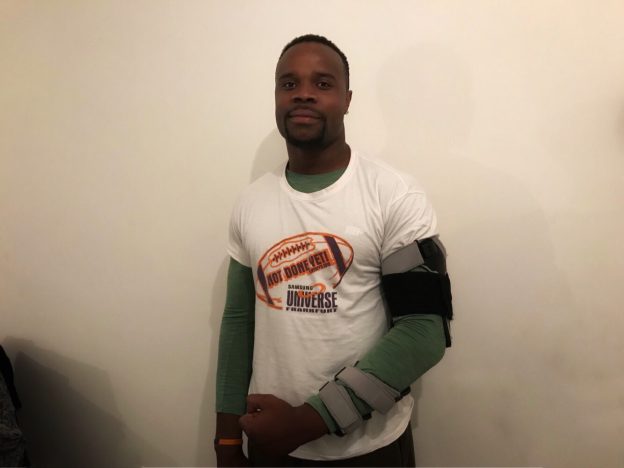
American Football star treated with CDS Elbow Brace

Brace Orthopaedic was recently contacted by Jean-Richard Wohi, an American Football professional playing for the fourth best team in Europe, Frankfurt Universe. During this season he sustained a season ending injury, rupturing his triceps tendon and required surgery.


His surgery was successful, and he was then placed in a cast for three days. After that, German doctors supplied a CDS (Controlled Dynamic Stretch) Elbow Extension brace and he was told to wear the brace for the next six weeks. CDS works on the principle of low load prolonged stretch and offers a dynamic assistance which can be fine-tuned to the patient, both in terms of force and range of movement adjustment.


Richard, like most professional athletes, has sustained a number of injuries over the years, but commented “This is by far the best product I have ever used and has been a godsend in my recovery. What makes this brace special, is the mechanics contained within it. It assists extension and so it helps my triceps to work easier while it’s healing. It’s also made to restrict movement in the joints to set angles, which in my case were 60, 90 and 120 degrees, which had to be set every two weeks. The first adjustment was done by a Physiotherapist in Germany who had experience adjusting the brace, but then I returned to the UK and was concerned I may not find the same assistance. I contacted Brace Orthopaedic, the distributors of the product, and asked if they had someone in the West Midlands who could assist. I was helped by a lovely lady on the phone called Cathryn who organised for Alex Falkonakis to come and adjust my brace. It was a very professional and prompt service and I could not recommend this product or company more highly.”


If you would like to hear more about Brace Orthopaedic’s range of CDS braces or indeed arrange a product demonstration then please call Customer Services on 0191 258 8944 where Cathryn or Iain would be delighted to help. Alternatively, please visit our website at www.braceorthopaedic.co.uk

linkedinmail

Brace Orthopaedic presents new contracture brace for below knee amputees at BACPAR.

CDS (Controlled Dynamic Stretch) orthoses are widely considered to be the leading active dynamic braces for managing contractures in orthopaedic and neurological applications, as well as others (burns & plastics etc.). Their spring-loaded hinges allow the application of a constant, quantifiable torque around joints throughout the period of application. At the same time, the application of these braces does not hinder function and participation in ADL’s (as with static braces). The braces are available in a wide variety of sizes, from large adult, all the way to infant. The large, anatomically shaped, padded shells can be readily adjusted in shape and position by hand, ensuring a nearly customised fit and therefore minimising pressure by offering large surface areas over which the forces are applied on the skin. This reduces the risk for pressure sores and maximises comfort and compliance with patients. A wealth of other unique features allows clinicians to limit ROM in both flexion and extension, even at single degree increments if required. The braces are easy for patients or carers to apply and remove, by using simple on/off switches to engage/ disengage the torque, as well as special clips to prevent doing and undoing the hook and loop straps repetitively.

One of the most difficult types of contractures to manage are the knee flexion contractures in below-knee amputees. Many of those patients are dysvascular with long-standing mobility problems and other co-morbidities. As a result, some of them already present with knee flexion contractures before the amputation, while others often develop contractures post-operatively. Managing this type of contracture can be very difficult due to many different factors: manipulating a short stump in a proximal-third amputation to stretch the joint can be difficult, the patients often have poor motivation following surgery, assistance from family/ carers may be limited, etc.. Surgery is often not an option for those dysvascular patients, which can leave the w/c stump board as the most advanced technology used! Once established, a knee flexion contracture will usually further increase the energy cost of prosthetic ambulation. In some cases patients are fitted with special bent-knee prostheses, with poor functional and cosmetic outcomes. In other cases the flexion contracture will simply prevent prosthetic ambulation, with all the repercussions in terms of quality of life and extra cost of care.

A new CDS brace has recently been developed by our manufacturing partner Albrecht GmbH in Germany, for below-knee amputees with knee flexion contractures. It offers the same usual features and benefits of a CDS knee extension brace, but the part distal to the knee joint incorporates a shell that fits around the stump and can be adjusted in position as to how distally it extends. The shell can also be removed and the distal part of the brace can attach directly onto a prosthetic socket. As with standard CDS knee extension braces, this brace will also assist knee extension during sitting-to-standing and mid-stance, offering further functional benefits during gait. The CDS knee amputation brace was presented last week at the BACPAR (British Association of Chartered Physiotherapists in Amputee Rehabilitation) annual conference in Wolverhampton, where physiotherapists, prosthetists, orthotists and physicians had the chance to see it and consider its value for their patients.

If you would like to learn more about any of the Brace Orthopaedic portfolio of products, or to arrange a product presentation, please call Customer Services on 0191 258 8944 or alternatively visit www.braceorthopaedic.co.uk/products/


 linkedinmail

Brace Orthopaedic visit key German manufacturer

Cathryn Tong, Operations Manager and Gary Barrett, National Sales Manager recently travelled to Brace Orthopaedic’s main manufacturing partner, German company Albrecht GmbH for a two-day training and education meeting.

The purpose of the visit was to review new products and receive training & education ahead of their launch in the UK during the next year.

Albrecht GmbH is a highly innovative manufacturer delivering a pipeline of great new products that Brace Orthopaedic will be bringing to the UK market for the benefit of clinicians and users over the next 12 months.

Gary Barrett, Cathryn Tong, Beate Albrecht, Irene Albrecht and Sabine Albrecht.

Albrecht design and manufacture the unique CDS contracture braces, along with the modular MKS spinal range and dynamic Jack PCL knee brace.

“Albrecht’s R&D department have been busy yet again”, explained Gary. “We were introduced to several new products throughout our visit and look forward to introducing more high quality and innovative products to our customers in the coming months.

“The new generation Jack PCL knee brace looks a very exciting product, as you get the same dynamic functionality but it is now supplied with a much smaller and lower profile hinge, which is more intuitive to use benefitting both the clinician and patient alike.

“There has also been significant product development with our CDS braces”, said Cathryn.  “Our customers use these braces for treating joint contractures caused by neurological or orthopaedic conditions.  Currently these ‘off-the-shelf’ braces treat a single joint such as the elbow, wrist, knee or ankle. Brace Orthopaedic are now able to offer a solution across two separate joints with combination braces for the elbow/wrist and knee/ankle.”

“New product development never stops at Albrecht and we were given a sneak preview of more exciting products coming through the pipeline that were in the prototype stage”, added Gary. “This is great news for Brace Orthopaedic, as we always strive to bring new technology to our customers and it helps to cement our ethos of only working with partners that deliver products that are unique, innovative and deliver an enhanced patient compliance.”

If you would like to hear more about the combination CDS braces or you would like to arrange a training session on the new generation Jack PCL knee brace, please call the Brace Orthopaedic office on 0191 258 8944 where Cathryn or Iain would be delighted to help.  Alternatively please visit our website at www.braceorthopaedic.co.uklinkedinmail

Step-On 100LH

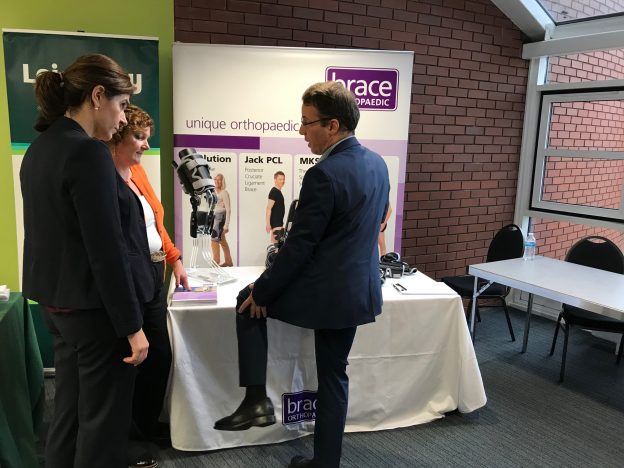
Brace Orthopaedic exhibiting at BAPO

BAPO 2017

Brace Orthopaedic is exhibiting at BAPO 2017 for the first time and will be showcasing its unique Step-On range of AFOs to the UK’s leading orthotists.

BAPO – The British Association of Prosthetists and Orthotists Annual Conference and Exhibition takes place this week (17-19 March) in the Ricoh Arena, Coventry.

Brace Orthopaedic has an exhibition stand and will be demonstrating the highly innovative Step-On AFO to interested professionals.

Step-On 100LH

Step-On 100LH

Step-On is a dynamic ankle-foot-orthosis for the treatment of drop foot. The unique feature of these AFOs is that they are articulated and offer adjustable dorsiflexion assistance, while being off-the-shelf products. This way they allow essential functional movements during the gait cycle, while at the same time providing the exact amount of control required by each patient, at every stage of their rehabilitation. Step-On AFOs are also lightweight, thermo-formable and easy to fit into a shoe.

“We’re thrilled to be attending BAPO as an exhibitor for the first time,” said Gary Barrett, National Sales Manager at Brace Orthopaedic. “It’s one of the big UK industry events in the calendar and we’re pleased to be supporting the event by providing a prize for the Benefit Prize Draw in aid of LimbPower.

“In addition to Step-On we will be showing our other unique braces and supports including our CDS range. The CDS braces are dynamic, spring-loaded orthoses which are used to treat joint contracture caused by neurological and orthopaedic conditions. At BAPO we’ll be exhibiting a range of these braces in both adult and paediatric sizes.”

This year’s BAPO focuses on pushing the boundaries, whether they be personal boundaries, societies’ boundaries or technical boundaries. The event is a great opportunity to network with others in the industry, meet with suppliers and keep up-to-date with leading research and advances in world of prosthetics and orthotics.

Brace Orthopaedic are exhibiting on Stand 14, you can visit us there or contact Gary Barrett in advance to arrange a meeting and demonstration of Step-On. Please contact Gary by calling 07841 482878 or emailing gary@braceorthopaedic.co.uklinkedinmail