Category Archives: Step-On-clinical

Step-On 200 dual hinge AFO: Options when you need them

With our recent pieces on the Step-On 100 medial and lateral hinge AFO options, you are probably wondering why the dual hinge? We thought that we would share some clinical scenarios which have been proven to be successful with the dual hinge, and demonstrate its adaptability. We hope it will help you in your decision making when prescribing a device from the Step-On family, and help you problem-solve a future similar scenario with good results.

Firstly, due to the dual hinge, we gain a slightly higher amount of power to dorsiflex the foot for swing, without any potential for transverse plane rotation. Therefore, we can better control the advance in tibial inclination in stance/resist reclination.

The extra control is especially useful for clients who have increased BMI, and/or exceptionally large and heavy feet with complete loss of power in the anterior compartment muscles; if you are struggling with swing clearance adequately with the Step-On 100, then 200 should be the solution. The extra control was especially useful in a client with a posterior distal thigh trauma with excision of large tumour, resulting in decreased hamstring power. The client had a mildly hyperextending knee and stress to the ACL with symptomatic pain. Due to trauma and CRPS a knee brace could not be used/tolerated, but the dual hinge resisted hyperextension adequately to incline the tibia forward, to prevent the problematic strain on the ACL. By dialling in on the hinge, the exact amount of control over the hyperextension moment at loading response was achieved, whilst still allowing the client a functional ankle range. Similarly, any client displaying dorsiflexor weakness and a mildly hyper extending knee, who demonstrates the ability to walk on a flexed knee, would do well with the 200 to help resist the mild hyperextension.

Having the dual hinge creates a much increased M-L stability, and clients who require increased M-L control are well-served. For those who have unstable ankles, or who excessively invert/evert, whereby the single strut would be struggling to hold the ankle position, we suggest the 200. Additional to the dual struts, its design offers an added feature of slotting the ankle straps in the tibial case for better purchase for valgus or varus control.

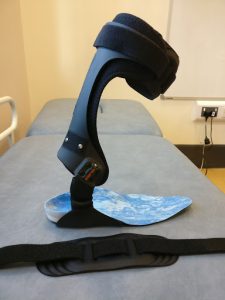
Step-On DH 200 functions

Another useful feature we have found is the four sizes: when choosing between the ‘Small’ to ‘Extra Large’, although the footplate length increases slightly, the most helpful and noticeable change is the bi-malleolar width, so we find although the shoe sizing is a useful indicator, we would like you to consider the bi-malleolar width first to ensure optimum fit at the ankle.

The Step-On 200, being part of the Step-On family, shares all the same high quality materials, heat mould ability, and ankle ROM and adjustment of the 100 options.

For more information about the Step-On 200 or to arrange a demo please contact the customer services team on 0191 258 8944 or email sales@braceorthopaedic.co.uk 

linkedinmail

A PTTD and post-polio case study – a pragmatic approach

A recent new client to the clinician, but not to the service recently required a revised prescription; complications with several rigid AFOs, one Ritchie styled, custom and OTS were a constant irritation. The client could see the benefits in gait, but this was outweighed by the irritation and discomfort felt for several years. A changing and worsening clinical picture meant that the client felt she required a new device; therefore reached out to the clinic for an opinion. A pragmatic approach with a fresh set of eyes, and the excellent new dynamic Step-On 100 AFO in the lateral hinge solved a chronic problem.

A bit of background to the client: Polio, Female, 72, Active; recently felt although undiagnosed that the increased weakness in unilateral dorsiflexion previously oxford 3, now at 2; was down to post-polio syndrome, alongside a 6mm LLD, and good UL dexterity.  It appeared, rather deceptively easy to treat; a saggital swing phase safety issue, reasonable control of tibial progression, with typical circumduction / steppage compensations; which were becoming harder to make due to new proximal increases in weakness,  and no long term dependency on a device as intervention was absent until later life. An easy fix, or so it seemed.

Diving into the assessment, with incomplete notes, taking history from the client it appeared in her mid-50s that a Talonavicular fusion was undertaken due to Posterior tibialis tendon overstrain.  I presumed the surgeon considered a triple arthrodesis to have increased risk of complications. The calcaneus was in valgus with some correction, but therefore midtarsal unstable, and PTT under strain even with the fusion.  An extremely prominent medial malleoli, medial STJ axis, low talo-crural angle where found, and indicative of factors of irritation of previous enclosed M-L custom AFOs, and sited by the client for reasons for decreased compliance, understandably so, history of subcutaneous bursa, and sores. The client was unsuitable for a revision surgery, so a medial calcaneal displacement osteotomy etc was out of the question; and if it was an option the client was too active to risk a period of non-WB and post op weakness; we had to work with this presentation.

Step-On® 100 LH Innovative ankle-foot-orthosis - Lateral Hinge

Step-On® 100 LH Innovative ankle-foot-orthosis – Lateral Hinge

A decision was made to treat the sagittal swing phase issue with the Step-On 100, the hinge provides 22° dorsiflexion and 11° plantar flexion with adjustable dorsiflexion assist to allow precise tuning of the dorsi assistance based on the weakness encountered, and the plantar flexion useful as it will self-adapt to the varying different shoe pitches, the client found this highly practical as a lady, and a complete revelation to her.

The dorsiflexion ROM was especially useful due to the newly encountered proximal weakness in swing, and further helped by the 290g weight to reduce a pendulum effect on swing. The lateral strut allowed no containment of the problematic prominent medial malleoli, but the patient still presented with symptomatic PTT. The Step-On 100 has a lower tibial strap which anchors to the lateral strut to reduce the valgus heel tendency, this was used for 4/52 to assess if tolerated and it was, the client had her sagittal problem resolved with no pressure issues, the client although safe and more functional still had PTT strain rated at 7/10 from 9/10.

This progress was built upon by next manufacturing a semi corrective FFO in order to help reduce the kinetic strain on the tissue. The flat Step-On ¾ footplate with neutral profile is ideal for adding an FFO to the stable base, this was key to the successful treatment. We have found that alternating between the Step-On AFO with the corrective ankle strap solely and adding in the FFO for several hours through the week in conjunction with the Step-On to have an optimum effect of finally bringing this patient to a pain score of 2/10. 

The Step-On again illustrated just how versatile its reach is across another pathology.

For more information about the Step-On 100 or to arrange a demo please contact the customer services team on 0191 258 8944 or email sales@braceorthopaedic.co.uk 

linkedinmail
Step-On 100LH

A progressive AFO solution for drop foot

We felt that we had to re-evaluate the approach to treat this group of clients by not relying on an all too common rigid AFO prescription or presuming a patient will require a single static orthosis for the duration of treatment. A dynamic AFO that could be matched to target the level of deficit only, and altered as the client rehabilitated was key.

Fibular region entrapment is the most common peroneal neuropathy; anatomically it’s unsurprising due to the peroneal nerve being superficial, it is therefore vulnerable to trauma or iatrogenic injury. Radiculopathy at L5 is the most commonly recognised cause of drop foot, largely due to disc herniation or foraminal stenosis. EMG and nerve conduction studies are useful to differentiate between the causation by pin-pointing the lesion, revealing the pathophysiology and establishing the prognosis.

The superficial peroneal branch innervates principally the evertor muscles, and the deep branch the dorsiflexor muscles of anterior compartment. Normally ankle inversion and plantar flexion should be unaltered, +/- ankle eversion depending on the branches affected. Clients often present with foot drop / slap, steppage gait, and sensory disturbance over the lateral calf and dorsum of the foot, +/- lateral ankle instability.

What the above should illustrate is that functional deficit and the recovery are unpredictable, changeable and unique to each client.

Rigid AFOs in this case can take away the primary problem of swing phase plantar flexion, and undoubtedly increase safety. In an active user who can demonstrate the ability to control tibial advancement, blocking dorsiflexion, metatarso-phalangeal joint (MTPJ) extension, and not allowing plantar flexion in loading response, can lead to unwanted compensations, which could result in resistance to using the AFO, weakness in the unaffected muscles, and decreased proprioception and balance.

The answer was the Step-On 100 AFO, specifically with the medial hinge for this group. It has afforded us the ability to target the AFO intervention to the needs and progress of the client, preventing over-bracing, and maximising the client effort.

Step-on 100 with Lateral Hinge (LH)

Step-on 100 with Lateral Hinge (LH)

The hinge provides a ROM of between 22° dorsiflexion and 11° plantar flexion, to cover all stages of the gait cycle. The ¾ footplate allows MTPJ extension, and the adjustable dorsiflexion assist allows precise control of the amount of assistance, based on the weakness encountered. The plantar flexion has been useful to accommodate varying shoe pitch, and gastrocnemius shortening of up to 5° easily, and to facilitate normal dorsiflexors to work eccentrically in loading response. In cases of lateral instability with a rearfoot varus due to evertor weakness, the option to attach a stabilising strap to the medial strut to resist inversion was particularly useful, and allowed prominent malleoli to be cleared, but equally could not be fitted in cases of isolated dorsiflexion weakness with good peroneal activity as to not functionally over-brace.

Our experience to date has shown us additionally that the posterior calf section stays clear of the insensate areas that can be particularly hyper sensitive, or irritated by anterior shell / proximal trim line AFOs. The shorter calf section trim line is distal of the fibular peroneal region in cases of trauma and surgical sites, particularly helpful for post-op total knee arthroplasty clients with iatrogenic injury, who need to wear a knee brace in conjunction with the AFO.

Clients have found shoe fit a breeze, the removable liner comfortable, and if any adjustments are required, the polypropylene can be heated to a suitable fit; though to date we’ve not been required to do so. We are happy that as the patients’ ROM and strength improves, we will not need to transfer them into a different AFO, but actually keep adjusting the Step-On for optimal performance in gait, so that we do not impede recovery.

For more information about the Step-On® 100 MH or to arrange a demo please contact the customer services team on 0191 258 8944 or email sales@braceorthopaedic.co.uk

linkedinmail