

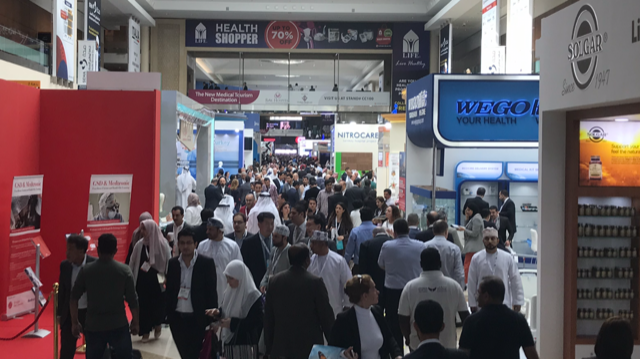
Arab Health is staggering in terms of its size and the statistics quickly confirm that. As the largest gathering of healthcare and trade professionals in the MENA (Middle East and North Africa) region, it boasts more than 5,000 exhibitors and 100,000 attendees from across 150 countries. This year it expects to build on the estimated US$778 million generated in business deals between medical manufacturers and attendees at last year’s show.
One of the main themes to this year’s exhibition is innovation, which fits well with the orthopaedic bracing products I represent in the UK with my Brace Orthopaedic business and internationally through my Step-On International business. So ‘wearing two hats’, I am looking for new innovative bracing products to bring to the UK market and also trying to locate premium distributors in countries where we are yet to launch the unique Step-On AFO.
My focus has always been on innovation and the pace at which it is moving in the healthcare industry is incredible. Highlighted here at Arab Health this week, the most prominent areas covered are AI, Smart Devices, Telemedicine Platforms and Health Monitors.
So what about orthopaedic bracing?
I am afraid my thirteen years of experience in this particular niche area of the orthopaedic industry tells me that innovation moves much more slowly here. This exhibition appears to be no different and so far I have only seen the usual ‘me too’ variations on what I have viewed a hundred times before. And yet the global market for orthotics is vast, so why is there an obvious lack of new and truly innovative products to discover? Maybe the answer lies in the fact that across the world and regardless of the type of reimbursement system, the pressure on pricing is relentless. So the challenge for the manufacturing companies is to try and maintain margin, but with a lower return. Inevitably many simply reduce the quality of their offering and we end up in a downward spiral. This is a dangerous road to go down. Often this means that patients are being braced with inferior products, which may not aid their rehabilitation, potentially creating problems and additional costs further down the line. So I would suggest a false economy.
I take a more positive approach. There will always be a handful of inventors, or manufacturers that see the value of investing in R & D to create the next generation of unique products. Products that will have added value. Products that offer the clinician a new treatment option and the patient a better, or quicker rehabilitation outcome. This is where the ‘good stuff’ happens and that is where I will continue my search…..